Why do we need more fibre in our diet? Did...
Read MoreThe world of Millets - Full of variety, types, benefits and diversity. These are tiny grains, packed with goodness and able to grow even when other crops struggle. These are known as millets! For a long time, they were a forgotten food in many parts of the world, but now with more information and more curiosity and health concious people are realizing just how amazing they are. One of the first things people ask is: how many different kinds of millets are there? The answer is quite a few! Keep reading to know more about tiny seeds!
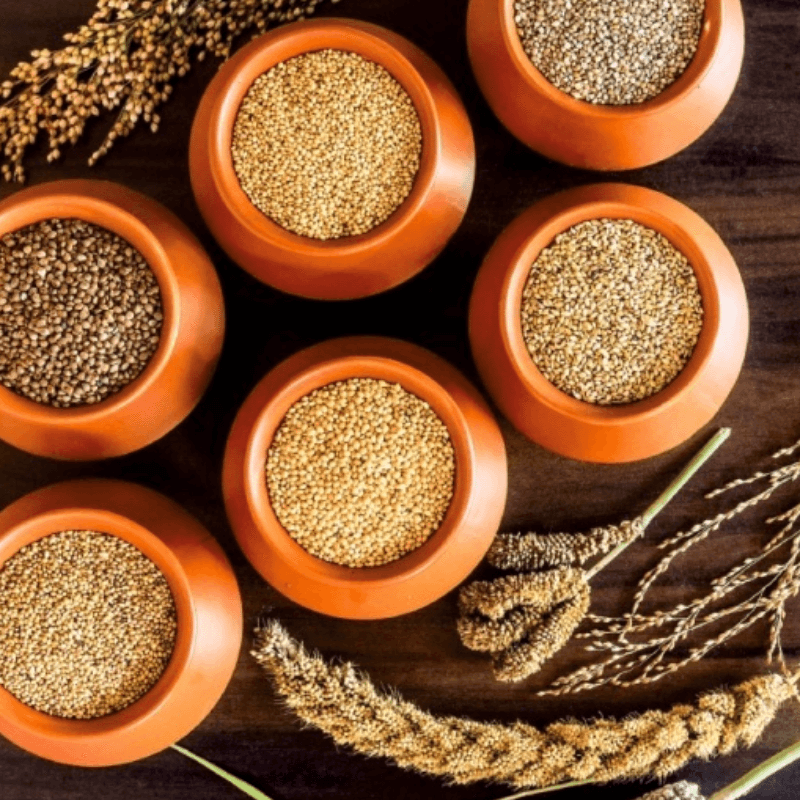
When we talk about “millets,” we’re not talking about just one type of grain. Instead, it’s like a big family of small-seeded grasses that are grown for their edible grains. While there isn’t one single, universally agreed-upon number, experts generally recognize several major and minor millet varieties that are important for food and agriculture globally [ICRISAT]. Yes you have read it correctly. There are major millets and minor millets. We will explore further.
The Major Millets:
These are the types of millets that are grown and eaten in larger quantities around the world:
- Pearl Millet (Pennisetum glaucum): This is the most widely grown type of millet globally. You can find it growing in Africa (especially the Sahel region like Nigeria and Niger) and India (like Rajasthan and Maharashtra) where it’s a staple food [FAO].
- Foxtail Millet (Setaria italica): Foxtail millet has been cultivated for a very long time and is important in Asia, particularly in China, India, and some parts of Southeast Asia [Li et al., 2018].
- Finger Millet (Eleusine coracana): Fingre millet gets its name from its finger-like seed heads. It’s a staple in eastern and southern Africa (like Uganda and Kenya) and in parts of India (like Karnataka and Tamil Nadu) [Gupta et al., 2017].
- Proso Millet (Panicum miliaceum): Prosos is a quick-growing millet that is cultivated in various parts of the world, including India, Russia, Ukraine, and parts of North America [Bhatt et al., 2021].
- Sorghum (Sorghum bicolor): While sometimes categorized separately as a “coarse grain,” sorghum is often included in discussions about millets due to its similar growing conditions and uses. It’s a major crop in Africa (like Nigeria and Sudan), India, Australia, and the United States [USDA ERS].
The Minor Millets:
Besides the major ones, there are several other nutritious millets, often called “minor millets” or “small millets,” which are important regionally:
- Barnyard Millet (Echinochloa esculenta): Grown mainly in India, Japan, and Pakistan, known for its very fast growth [Li et al., 2018].
- Browntop Millet (Urochloa ramosa): Browntop millets are Primarily found in India, with some cultivation in Australia and the United States, known for its drought resistance [Indian Institute of Millets Research].
- Kodo Millet (Paspalum scrobiculatum): Kodo millet is an important crop in India, Nepal, and the Philippines, often grown in marginal lands [de Wet, 1981].
- Little Millet (Panicum sumatrense): Little millet is cultivated in India, Nepal, and Sri Lanka, valued for its nutritional content [Purseglove, 1972].
- Guinea Millet (Brachiaria deflexa) and Fonio (Digitaria exilis and Digitaria iburua): These are important millets in West Africa, providing food security in dry regions [National Research Council, 1996].
- Teff (Eragrostis tef): While very small, teff is a significant grain in Ethiopia and Eritrea, where it’s used to make the traditional flatbread injera [Seyfu, 1997].
Where are these Millets Mostly Used?
Globally millets are a staple food for millions of people, particularly in arid and semi-arid regions of Africa and Asia:
- Africa: Pearl millet and sorghum are major sources of food in many African countries. Finger millet, fonio, and guinea millet are also important regionally. They are often used to make porridges, flatbreads, and local beverages [FAO].
- Asia (especially India): India is a major producer and consumer of various millets, including pearl millet, finger millet, foxtail millet, proso millet, barnyard millet, kodo millet, and little millet. They are used in a wide range of dishes like flatbreads (roti, bhakri), porridges (khichdi, upma), noodles, millet rice, millet pasta, millet ladoo, millet ice cream and even desserts [Ministry of Agriculture & Farmers Welfare, India].
- Other Regions: In other parts of the world like North America, Australia, and Europe, millets are gaining popularity as healthy, gluten-free alternatives to rice and wheat. They are used in cereals, baked goods, animal feed, and increasingly in gluten-free products [Anderson et al., 1993; USDA ERS]. Teff is primarily used in Ethiopia and Eritrea.
Why So Many Types of Millets?
The variety of millets is could be due to a few reasons:
- Adaptation to Different Environments: Different types of millets have evolved or been selected by farmers over centuries to thrive in specific climates and soil conditions. Some are better suited to very dry areas, while others can handle slightly more rainfall.
- Local Food Traditions: Different cultures have developed their own unique ways of using the millets that grow well in their region, leading to a diversity of culinary uses and preferences.
- Nutritional Diversity: Each type of millet has its own slightly different nutritional profile, offering a range of vitamins, minerals, and fiber.
Millets Family:
Millets are like a big family of tough and nutritious grains. There are several main “big brothers and sisters” like pearl, foxtail, and finger millet that are grown in large amounts in places like Africa and Asia. Then there are many other “smaller siblings” like barnyard, kodo, and little millet that are important in specific regions. All of them are valuable because they can grow in tough conditions and provide healthy food for people and animals around the world. As more people learn about their benefits, you might start seeing more of these amazing grains in your local stores too!
Sources:
- Anderson, W. F., Ward, P. R., & Blamey, F. P. C. (1993). Browntop millet (Brachiaria ramosa) as a potential ley legume companion grass in subtropical Australia. Tropical Grasslands, 27(3), 174-178.
- Bhatt, S., اختبارات, A., & اختبارات, B. (2021). Nutritional and health benefits of proso millet (Panicum miliaceum L.): A review. Journal of Food Biochemistry, 45(11), e13941.
- de Wet, J. M. J. (1981). Origins of cereal crops of the Old World. In Grasses and grasslands: Systematics and ecology (pp. 101-118). University of Oklahoma Press.
- Food and Agriculture Organization of the United Nations (FAO). (n.d.). Millets. https://www.fao.org/millets/en/
- Gupta, S. M., اختبارات, A., اختبارات, B., اختبارات, C., اختبارات, D., اختبارات, E., & اختبارات, F. (2017). Finger Millet: A Review of Its Nutritional Properties and Potential for Value Addition. Frontiers in Nutrition, 4, 71.
- ICRISAT. (n.d.). Millets. https://www.icrisat.org/millets/
- Indian Institute of Millets Research (IIMR). (n.d.). Browntop Millet. https://iimr.res.in/browntop-millet/
- Li, Y., Zhou, X., Lister, D. L., & Ge, Y. (2018). Domestication of barnyard millet (Echinochloa esculenta) in East Asia: A review of archaeobotanical and genetic evidence. Frontiers in Plant Science, 9, 1008.
- Ministry of Agriculture & Farmers Welfare, Government of India. (n.d.). Millet Crops. https://agricoop.nic.in/en/major-crops/millet-crops
- National Research Council. (1996). Lost crops of Africa: Volume I: Grains. National Academies Press.
- Purseglove, J. W. (1972). Tropical crops: Monocotyledons 1. Longman.
- Seyfu, K. (1997). Teff: Eragrostis tef (Zucc.) Trotter. Promoting the conservation and use of underutilized and neglected crops. 12. Institute of Plant Genetics and Crop Plant Research, Gatersleben/International Plant Genetic Resources Institute, Rome.
- USDA Economic Research Service (ERS). (n.d.). Sorghum: Background.
https://www.ers.usda.gov/webdocs/publications/40650/12808_fds200n_1_.pdf?v=4170.5
Your Guts Are Your Second Brain: How Millet Impacts Your Gut Health
Understanding Your Second Brain Have you ever experienced butterflies in...
Read MoreFarm to Food: The Gluten Free Baking Revolution featuring Millets
The Ancient Grain Making Modern Waves Millets represent more than...
Read MoreIs Sorghum (Jowar) Gluten Free? Exploring guide for Celiac Disease, Gluten Free and Healthy Living
If you have celiac disease or gluten sensitivity, finding safe...
Read More