Why do we need more fibre in our diet? Did...
Read MoreUnderstanding the nutritional component on your plate
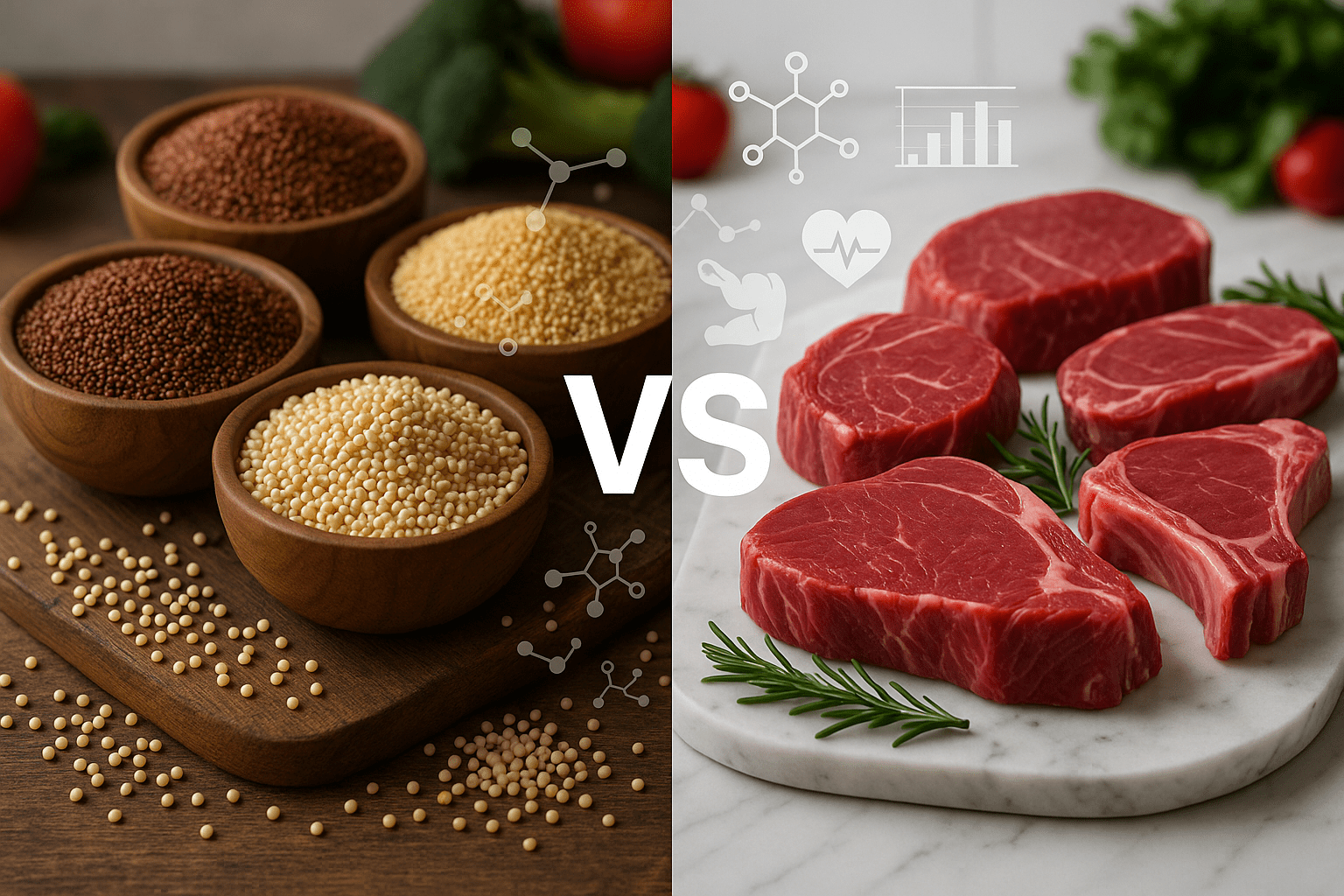
In today's health conscious world, choosing the right foods for optimal nutrition has become more important than ever. Two food groups that frequently spark debate amongst nutrition enthusiasts are millets and red meat. Both offer unique nutritional profiles, but how do they truly compare? This comprehensive guide on Millets vs. Red Meat explores the science behind these nutritional characteristics and helps you make informed dietary choices.
IMPORTANT MEDICAL DISCLAIMER:
This blog post is for informational purposes only and should not replace professional medical advice. Everyone's nutritional needs are unique, and individual health conditions may require specific dietary modifications. Please consult with a qualified healthcare professional, registered dietitian, or nutritionist before making significant changes to your diet, especially if you have existing health conditions, allergies, or specific dietary requirements. The information provided here is based on current research and general guidelines, but professional guidance is essential for personalised nutrition planning.
What Are Millets?
Millets are ancient grains that have been cultivated for thousands of years across Africa, Asia, and other regions. These small seeded cereals include varieties such as pearl millet, finger millet, foxtail millet, and sorghum. Millets contain about 65–75% carbohydrates, 7–12% proteins, 2–5% fat, and 8–15% fiber, making them a well balanced nutritional option.
What makes millets particularly special is their resilience. The cultivation of millets requires relatively low inputs compared to other cereals, as they demand less water and exhibit resilience to diseases and pests. This environmental sustainability factor has contributed to their growing popularity worldwide.
Understanding Red Meat Nutrition
Red meat encompasses animal proteins from mammals, primarily beef, pork, lamb, and venison. Red meat is distinguished from white meat (poultry and fish) by its higher myoglobin content, which gives it the characteristic red colour. Red meat provides us with iron, zinc and B vitamins. Red meat is highly nutritious and contributes with several essential nutrients which are difficult to obtain in the right amounts from other food sources.
The nutritional profile of red meat varies depending on the cut, feeding practices, and preparation method. However, all red meats share the common characteristic of being complete proteins, containing all essential amino acids required by the human body. Red meat is also one of the richest sources of heme iron, which is more easily absorbed by the body than non-heme iron found in plant foods.
Nutritional Comparison: Millets vs Red Meat
Protein Content and Quality
When it comes to protein, red meat takes the lead in both quantity and quality. A 3-ounce serving of red meat has about 45% of the Daily Value (DV) of protein. Red meat proteins are considered complete proteins, containing all nine essential amino acids in optimal proportions.
Millets, whilst containing protein, provide a lower amount. Millet is rich in protein and calcium and has more essential amino acids than most other cereals. However, millet proteins are generally incomplete, meaning they lack one or more essential amino acids. This doesn’t make them inferior, but it does mean they need to be combined with other protein sources for optimal amino acid profiles.
Carbohydrates and Fibre
Here’s where millets shine brilliantly. Millets are rich in fiber and non-starchy polysaccharides, two types of undigestible carbs that help control blood sugar levels. This cereal also has a low glycemic index (GI), making it excellent for blood sugar management.
Red meat contains virtually no carbohydrates, which can be advantageous for low carb diets but means you’ll need to source your energy from other foods.
Micronutrients
Both food groups excel in different micronutrient areas. Red meat is one of the main sources of vitamin B12 in the diet. A serving of red meat is also a good source of zinc, which can help the body produce testosterone, and selenium, a powerful antioxidant. Plus, red meat is exceptionally rich in heme iron, which is more easily absorbed than the non-heme iron found in plant foods.
They rank favorably in both micro and macronutrients, showcasing superior mineral content and essential amino acid profiles compared to mainstream cereals like wheat and rice. Millets are nutritionally advantageous, consisting of carbohydrates, antioxidants, and biologically active compounds such as flavonoids, carotenoids, phenolic acids, minerals, and vitamins.
Antioxidants and Phytonutrients
Millets have a clear advantage in antioxidant content. These molecules act as antioxidants, helping to combat oxidative stress in the body. The various phytonutrients in millets contribute to their potential health protective effects.
Red meat, particularly processed varieties, generally contains fewer antioxidants, though certain cuts may contain some beneficial compounds like carnosine and taurine.
Health Benefits Comparison
Cardiovascular Health
Moreover, millets offer several health benefits, such as preventing diabetes, cardiovascular conditions, and some types of cancer. The high fibre content and low glycemic index of millets contribute to better heart health by helping to manage cholesterol levels and blood pressure.
Red meat consumption has been associated with mixed cardiovascular outcomes in research. Whilst red meat provides essential nutrients, excessive consumption of processed red meat may increase cardiovascular risks. However, lean cuts of red meat as part of a balanced diet can provide valuable nutrients without significantly impacting heart health.
Diabetes Management
Fiber-rich foods have a low glycaemic index and can reduce the risk of oxidative stress and metabolic illnesses. This makes millets particularly beneficial for individuals managing diabetes or prediabetes.
Red meat, being virtually carbohydrate free, doesn’t significantly impact blood glucose levels, making it suitable for diabetic diets when consumed in appropriate portions.
Weight Management
Both foods can support weight management in different ways. Millets provide sustained energy due to their complex carbohydrate structure and high fibre content, promoting satiety. Red meat’s high protein content also promotes satiety and supports muscle maintenance during weight loss.
Creating a Balanced Diet: Combining Millets and Red Meat
The question isn’t whether to choose millets or red meat, but rather how to incorporate both effectively into a balanced diet. Here are some practical guidelines:
Daily Recommendations:
- Include 1-2 servings of millets as part of your grain intake
- Consume moderate portions of lean red meat (about 3-4 ounces) 2-3 times per week
- Balance your plate with vegetables, fruits, and healthy fats
Meal Planning Ideas:
- Breakfast: Millet porridge with nuts and fruits
- Lunch: Lean beef stir-fry with vegetables and millet grain
- Dinner: Small portion of red meat with steamed vegetables and millet pilaf
Global Dietary Patterns: Different cultures have successfully combined grains and red meat for centuries. Mediterranean diets include moderate red meat consumption alongside whole grains, whilst Asian cuisines often feature small portions of red meat with grain-based dishes.
Sustainability and Environmental Considerations
When comparing millets and red meat, environmental impact becomes an important factor. Millets are among the most sustainable grains, requiring minimal water and thriving in arid conditions. They also have a very low carbon footprint compared to animal proteins.
Red meat production has a significantly higher environmental impact, requiring more water, land, and producing more greenhouse gases. This doesn’t mean eliminating red meat entirely, but rather consuming it mindfully and choosing sustainably raised options when possible.
Overall
Both millets and red meat offer unique nutritional benefits that can complement each other in a well-balanced diet. Millets provide complex carbohydrates, fibre, and plant-based nutrients, whilst red meat delivers high-quality protein, essential amino acids, and bioavailable nutrients like iron and vitamin B12.
The key lies in moderation and balance. Include millets as a nutritious grain option that supports blood sugar management and provides sustained energy. Complement this with moderate portions of high-quality red meat to ensure adequate protein and essential nutrient intake.
Remember that individual nutritional needs vary based on age, activity level, health conditions, and personal preferences. The combination of millets and red meat can be part of a healthy dietary pattern when consumed as part of a diverse, balanced diet rich in vegetables, fruits, and other whole foods.
References
- Anitha, S., Kane-Potaka, J., Tsusaka, T. W., et al. (2024). “The nutrition and therapeutic potential of millets: an updated narrative review.” Frontiers in Nutrition, 11, 1346869. Available at: https://www.frontiersin.org/journals/nutrition/articles/10.3389/fnut.2024.1346869/full
- Khanna, P., Sharma, S., Kaur, G., et al. (2024). “Variation in the nutrient content of different genotypes and varieties of millets, studied globally: a systematic review.” Frontiers in Sustainable Food Systems, 8, 1324046. Available at: https://www.frontiersin.org/journals/sustainable-food-systems/articles/10.3389/fsufs.2024.1324046/full
- Sharma, S., Saxena, D. C., & Riar, C. S. (2024). “Millets: Exploring their genetic diversity, nutritional composition, and pharmacological potentials.” Food Chemistry Advances, 4, 100625. Available at: https://www.sciencedirect.com/science/article/abs/pii/S2949824424002325
- Anitha, S., Govindaraj, M., & Kane-Potaka, J. (2020). “The nutritional use of millet grain for food and feed: a review.” Agriculture and Food Security, 9(1), 16. Available at: https://www.ncbi.nlm.nih.gov/pmc/articles/PMC8005370/
- Gannon, B., Kaliwile, C., Arscott, S. A., et al. (2021). “Can Millet Consumption Help Manage Hyperlipidemia and Obesity?: A Systematic Review and Meta-Analysis.” Frontiers in Nutrition, 8, 700077. Available at: https://pmc.ncbi.nlm.nih.gov/articles/PMC8416111/
- Lescinsky, H., Afshin, A., Ashbaugh, C., et al. (2022). “Health effects associated with consumption of unprocessed red meat: a Burden of Proof study.” Nature Medicine, 28(10), 2075-2082. Available at: https://www.nature.com/articles/s41591-022-01968-z
- Heianza, Y., Ma, W., Manson, J. E., et al. (2024). “Estimated effects of reductions in processed meat consumption and unprocessed red meat consumption on occurrences of type 2 diabetes, cardiovascular disease, colorectal cancer, and mortality in the USA: a microsimulation study.” The Lancet Planetary Health, 8(7), e441-e451. Available at: https://www.thelancet.com/journals/lanplh/article/PIIS2542-5196(24)00118-9/fulltext
- Fiolet, T., Srour, B., Sellem, L., et al. (2022). “Benefits and Risks Associated with Meat Consumption during Key Life Processes and in Relation to the Risk of Chronic Diseases.” Foods, 11(14), 2063. Available at: https://www.mdpi.com/2304-8158/11/14/2063
- Libera, J., Latoszek, E., Fff, M., et al. (2021). “Consumption of processed red meat and its impact on human health: A review.” International Journal of Food Science & Technology, 56(11), 5583-5594. Available at: https://ifst.onlinelibrary.wiley.com/doi/10.1111/ijfs.15270
- Comprehensive review on millets: Nutritional values, effect on health and processing aspects (2023). Journal of Drug Research in Ayurvedic Sciences, 8(Suppl 1), S110-S117. Available at: https://journals.lww.com/jdra/fulltext/2023/08001/comprehensive_review_on_millets__nutritional.14.aspx
Note: All references cited are from peer-reviewed scientific journals and systematic reviews. The findings represent current scientific understanding and may be subject to updates as new research emerges.
Your Guts Are Your Second Brain: How Millet Impacts Your Gut Health
Understanding Your Second Brain Have you ever experienced butterflies in...
Read More
Farm to Food: The Gluten Free Baking Revolution featuring Millets
The Ancient Grain Making Modern Waves Millets represent more than...
Read More
Is Sorghum (Jowar) Gluten Free? Exploring guide for Celiac Disease, Gluten Free and Healthy Living
If you have celiac disease or gluten sensitivity, finding safe...
Read More