
Why do we need more fibre in our diet? Did...
Read MorePeople are becoming more health concious and are looking for healthy grain alternatives in their daily diet. Rice has been a main food for billions of people, but lately sorghum is getting more attention. Lets compare what is sorghum and what is rice to help you understand which one might be better for your health and diet needs.
What is Sorghum?
Sorghum is an ancient grain that has been around for thousands of years. It looks like small round seeds and comes from a tall grass plant. The scientific name is Sorghum bicolor. This grain is very important in many parts of Africa and Asia, where people have been eating it for many generations. In some part it is also known as Sorgo!
Sorghum is naturally gluten-free, which makes it good for people who cannot eat wheat or other grains with gluten. It can grow in hot and dry places where other crops might not survive well. This make sorghum climate change friendly crop.
What is Rice?
Rice is one of the most popular grains in the world. It comes from the plant Oryza sativa and has been a main food for more than half of the world’s population. There are many types of rice such as white rice, brown rice, and coloured rice varieties.
White rice is the most common type, but brown rice keeps more of its nutrients because it still has the outer layer called bran. Rice grows in wet conditions and needs lots of water to grow properly. We will capture brown rice in our future blogs. With brown rice “bran” is the most important layer that makes a huge difference.
Sorghum vs Rice Nutrition Comparison
When we look at nutrition facts, research shows some interesting differences between sorghum and rice.
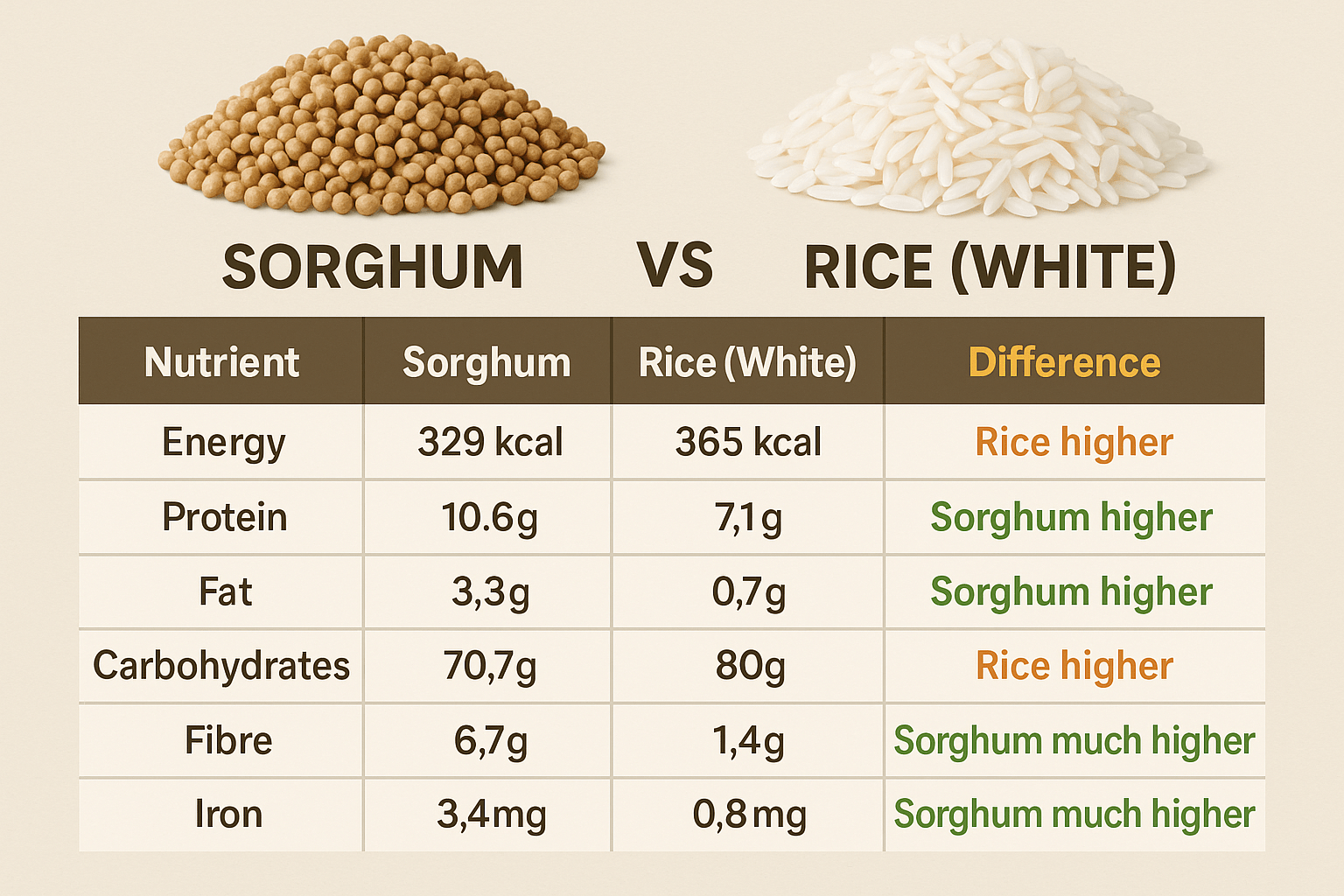
Nutritional Comparison Table
The table below shows the nutritional differences between sorghum and rice based on scientific research data³:
| Nutrient (per 100g) | Sorghum | Rice (White) | Difference |
|---|---|---|---|
| Energy (Calories) | 329 kcal | 365 kcal | Rice higher |
| Protein | 10.6g | 7.1g | Sorghum higher |
| Fat | 3.3g | 0.7g | Sorghum higher |
| Carbohydrates | 70.7g | 80g | Rice higher |
| Fibre | 6.7g | 1.4g | Sorghum much higher |
| Iron | 3.4mg | 0.8mg | Sorghum much higher |
| Magnesium | 165mg | 25mg | Sorghum much higher |
| Phosphorus | 289mg | 115mg | Sorghum higher |
| Zinc | 1.67mg | 1.09mg | Sorghum higher |
| Manganese | 1.63mg | 1.09mg | Sorghum higher |
| Vitamin B1 | 0.33mg | 0.07mg | Sorghum much higher |
| Vitamin B3 | 2.93mg | 1.62mg | Sorghum higher |
Source: Food Structure nutrition comparison database³
The table above shows that sorghum provides significantly more protein, fibre, and most minerals compared to white rice. The only areas where rice is higher are total energy (calories) and carbohydrates.
Protein Content Scientific studies show that sorghum has better nutrition than rice and cassava in several areas¹. Research published in PMC indicates that coloured rice, coloured corn and sorghum, contain richer essential nutrients, dietary fibre, and essential amino acids compared to white rice and corn².
Mineral Content As shown in the table above, nutrition comparison data shows that rice has less manganese, magnesium, phosphorus, iron, vitamin B6, fibre, copper, vitamin B1, vitamin B3, and zinc compared to sorghum grain³. This means sorghum provides more important minerals that your body needs.
Glycemic Index Benefits Research indicates that sorghum has a lower glycemic index than white rice, making it a better option for blood sugar control⁴. Studies also show that sorghum flour has a lower glycemic index compared to rice flour, meaning it causes a slower and more gradual rise in blood sugar levels⁵.
Health Benefits Comparison
Both grains offer health benefits, but they work differently in your body.
Blood Sugar Management Sorghum appears to be better for blood sugar control than white rice. The lower glycemic index means it may help prevent quick spikes in blood sugar levels. This could be helpful for people who want to manage their blood sugar better.
However, it is important to note that brown rice, a whole grain, is nutritionally superior to white rice and closer to sorghum in terms of fibre and nutrients⁶.
Digestive Health Both grains can support digestive health, but sorghum generally has more fibre than white rice. Fibre helps your digestive system work properly and may help you feel full for longer periods.
Mineral Support Sorghum provides more minerals like manganese, magnesium, and iron compared to rice. These minerals are important for bone health, energy production, and blood health.
Environmental Impact Comparison
The way these grains are grown affects the environment differently.
Water Usage Rice production requires much more water than sorghum. Scientific research shows that rice farming threatens freshwater resources, while also being increasingly vulnerable to drought due to climate change⁷.
Research indicates that groundwater resources are being rapidly depleted in breadbaskets like the North China Plain, Punjab Region, and High Plains to irrigate water-guzzling rice and wheat⁸.
Climate Resilience Studies suggest that drought has been found to be one of the major environmental factors limiting both the quantity and quality of rice, maize, sorghum and wheat production in Africa and South Asia⁹. However, sorghum generally handles drought conditions better than rice.
Cooking and Preparation Differences
Both grains can be cooked in similar ways, but they have different textures and cooking times.
Sorghum Preparation Sorghum takes longer to cook than rice – usually about 45-60 minutes. You can cook it like rice by using about 3 cups of water for every 1 cup of sorghum. It has a chewy texture that some people really enjoy. To get the maximum benefits of Sorghum, it is highly recommended to soak for at-lest 6 hours prior to cooking. If you soak for 6 hours then boil cooking will only take 12minutes at full heat.
Sorghum can be popped in the microwave or on the stovetop, just like popcorn¹⁰. This makes it a fun snack option.
Rice Preparation Rice cooks much faster than sorghum – usually 15-20 minutes for white rice and 30-45 minutes for brown rice. It has a softer texture that many people are familiar with.
Cost and Availability
Rice is more widely available and usually costs less than sorghum in most places. You can find rice in almost any grocery store, whilst sorghum might be harder to find and more expensive.
However, as more people learn about sorghum’s benefits, it is becoming more available in health food stores and online.
Which is Better for Weight Management?
Both grains can be part of a healthy diet for weight management, but they work differently.
Sorghum may be better for weight management because:
- It has more fibre, which can help you feel full
- It has a lower glycemic index, which may help control hunger
- It provides more protein per serving
Rice can also support weight management, especially brown rice, because it provides energy and can be part of balanced meals.
Gluten-Free Options
Both sorghum and rice are naturally gluten-free, making them good options for people with coeliac disease or gluten sensitivity. This is important for people who cannot eat wheat, barley, or rye.
Cultural and Traditional Uses
Rice has been a traditional food in many Asian countries for thousands of years. It is a main part of meals in countries like China, India, Japan, and Thailand.
Sorghum has been traditional in African countries and some parts of India. In many places, people make porridge, flatbreads, or fermented drinks from sorghum.
Climate Change Considerations
Research shows that climate change affects both crops, but in different ways. The rice production system is one of the most climate change sensitive agro-ecosystems¹¹.
Sorghum may be more suitable for future farming because it can grow with less water and handle heat better than rice.
Processing and Varieties
Sorghum Types Sorghum comes in different colours – white, red, and brown varieties. Each type has slightly different nutrition and taste profiles.
Rice Types Rice has many varieties including short grain, long grain, brown rice, white rice, and speciality types like basmati and jasmine rice.
Things to Consider
When choosing between sorghum and rice, think about:
- Your health goals
- Cooking time available
- Taste preferences
- Budget
- Environmental concerns
- Availability in your area
Both grains can be part of a healthy diet, and you might want to include both for variety.
Sorghum Or Rice?
Sorghum and rice both have their advantages. Sorghum appears to offer better nutrition with more minerals, fibre, and a lower glycemic index. It is also more environmentally sustainable because it needs less water to grow.
Rice, especially brown rice, is still a nutritious choice and is more familiar to many people. It cooks faster and is more widely available.
The best choice depends on your personal needs, health goals, and preferences. You might consider trying both grains to see which one works better for your lifestyle and taste preferences.
As more research continues on both grains, we may learn even more about their benefits for human health and environmental sustainability.
References:
¹ ResearchGate – Nutrition values of sorghum, rice, corn, cassava, soybeans. https://www.researchgate.net/figure/Nutrition-values-of-sorghum-rice-corn-cassava-soybeans_tbl1_343606204
² PMC – National Center for Biotechnology Information (2024). Nutrient Composition of Indonesian Specialty Cereals: Rice, Corn, and Sorghum as Alternatives to Combat Malnutrition. https://pmc.ncbi.nlm.nih.gov/articles/PMC10764230/
³ Food Structure – Rice vs. Sorghum grain — In-Depth Nutrition Comparison. https://foodstruct.com/compare/rice-vs-sorghumgrain
⁴ ETprotein (2024). Is Sorghum Better Than Rice? https://www.etprotein.com/is-sorghum-better-than-rice/
⁵ Casa de Sante (2024). Sorghum Flour vs Rice Flour: A Comprehensive Comparison. https://casadesante.com/blogs/flour-guide/sorghum-flour-vs-rice-flour
⁶ ETprotein (2024). Is Sorghum Better Than Rice? https://www.etprotein.com/is-sorghum-better-than-rice/
⁷ Nature Communications (2023). Enhancing rice production sustainability and resilience via reactivating small water bodies for irrigation and drainage. https://www.nature.com/articles/s41467-023-39454-w
⁸ AgFunder News (2025). Ancient grains need modern solutions: how sorghum and millets can nourish a climate-era world. https://agfundernews.com/ancient-grains-need-modern-solutions-how-sorghum-and-millets-can-nourish-a-climate-era-world
⁹ International Atomic Energy Agency (2024). Improving Resilience to Drought in Rice and Sorghum through Mutation Breeding. https://www.iaea.org/newscenter/news/improving-resilience-to-drought-in-rice-and-sorghum-through-mutation-breeding
¹⁰ WebMD (2024). Sorghum: Nutrition and Health Benefits. https://www.webmd.com/diet/health-benefits-sorghum
¹¹ Frontiers in Microbiology (2022). Comprehensive Impacts of Climate Change on Rice Production and Adaptive Strategies in China. https://www.frontiersin.org/journals/microbiology/articles/10.3389/fmicb.2022.926059/full
Your Guts Are Your Second Brain: How Millet Impacts Your Gut Health
Understanding Your Second Brain Have you ever experienced butterflies in...
Read More
Farm to Food: The Gluten Free Baking Revolution featuring Millets
The Ancient Grain Making Modern Waves Millets represent more than...
Read More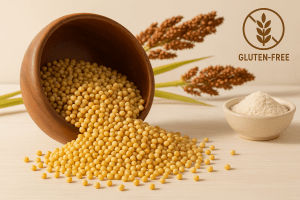
Is Sorghum (Jowar) Gluten Free? Exploring guide for Celiac Disease, Gluten Free and Healthy Living
If you have celiac disease or gluten sensitivity, finding safe...
Read More