Why Millets Matter – Why we need to pay attention?

Millet Characteristics

Millets are small-seeded grasses that have been cultivated for thousands of years across Asia and Africa. Unlike rice and wheat, millets require less water, grow well in poor soils, and are naturally pest-resistant—making them ideal for sustainable agriculture. But beyond their environmental benefits, millets are full of nutritional properties.

Comparing Nutritional Profiles: Millets vs. Rice and Wheat

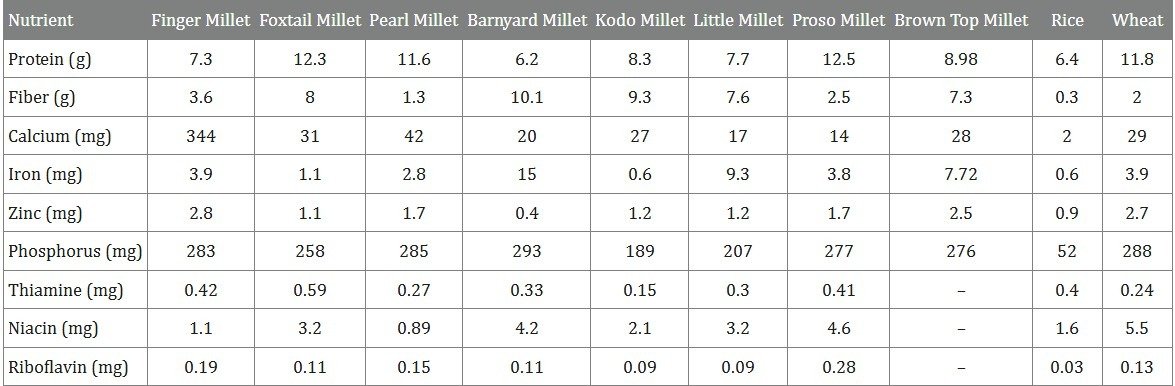
The study sourced in the blog analyzed the nutritional content per 100 grams of eight millets namely; Finger, Foxtail, Pearl, Barnyard, Kodo, Little, Proso, and Brown Top (All are english names of the millets, there are many local names for each of the millets depending upon the region and origin) —against rice and wheat. Here’s how they compared when put together:

Protein

Protein is essential for building and repairing tissues. While wheat has 11.8g and rice contains 6.4g of protein, several millets are either ahead or similar:

  • Proso Millet: 12.5g
  • Foxtail Millet: 12.3g
  • Pearl Millet: 11.6g

Fiber

Dietary fiber aids digestion and helps maintain blood sugar levels. Barnyard Millet tops the chart with 10.1g, followed by Kodo Millet at 9.3g and Foxtail Millet at 8g. Wheat has 2gm and Rice lags significantly with just 0.3g.

Calcium

Calcium is crucial for bone health. Finger Millet is a standout, offering 344mg—over ten times that of wheat (29mg) and rice (2mg).

Iron

Iron supports oxygen transport in the blood. Barnyard Millet provides a whopping 15mg, with Little Millet (9.3mg) and Brown Top Millet (7.72mg) also offering substantial amounts. Rice and wheat both offer only 0.6mg.

Zinc

Zinc is vital for immune function. Brown Top Millet leads among millets with 2.5mg, slightly below wheat’s 2.7mg but well above rice’s 0.9mg.

Phosphorus

Phosphorus supports bone and teeth formation. Barnyard Millet (293mg) and Pearl Millet (285mg) are on par with wheat (288mg), while rice has much lower at 52mg.

B-Vitamins

B-vitamins are essential for energy metabolism:

  • Thiamine (B1): Foxtail Millet offers 0.59mg, compared to wheat (0.24mg) and rice (0.4mg).

  • Niacin (B3): Proso Millet leads with 4.6mg, followed by Barnyard and Little Millets at 4.2mg and 3.2mg, respectively comapred to rice at 1.6mg and wheat 5.5mg.

  • Riboflavin (B2): Proso Millet again stands out with 0.28mg, compared to wheat’s 0.13mg and rice’s 0.03mg.


Health Benefits of Millets

Incorporating millets into your diet can offer numerous health advantages:

  • Diabetes Management: The high fiber content in millets helps regulate blood sugar levels.

  • Heart Health: Millets are rich in magnesium and potassium, which support cardiovascular health.

  • Weight Management: Their high satiety value can aid in controlling appetite.

  • Digestive Health: The fiber in millets promotes healthy digestion and prevents constipation.

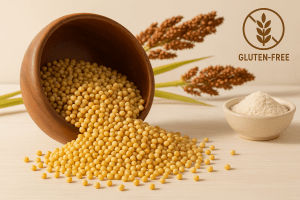
  • Naturally Gluten Free: Millets are naturally gluten free compared to Wheat which is a greater cause of celiac dieseas.

Culinary Versatility

Millets are incredibly versatile and can be used in various dishes:

  • Breakfast: Millet porridge, Millet Break, Millet flakes or upma.

  • Lunch/Dinner: Millet-based salads, pilafs, or as a rice substitute.

  • Snacks: Millet cookies, crackers, or energy bars.

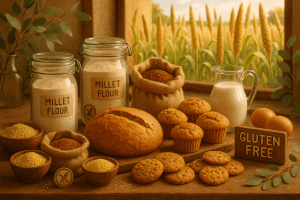
  • Baking: Millet flour can be used in bread, muffins, and pancakes.


Conclusion

Millets offer a compelling combination of health benefits and environmental sustainability. With their rich nutritional profiles, they stand as superior alternatives to traditional staples like rice and wheat. Incorporating a variety of millets into your diet can contribute to better health outcomes and support sustainable agriculture.


References:

  • Jacob, S., Krishnan, S., Antony, U., Bhavyasri, P., Aruna, M., Mishra, D., Nepolean, T., Satyavathi, C. T., & Visarada, K. B. R. S. (2024). Nutritional composition of 8 different types of millets in comparison to rice and wheat. Frontiers in Nutrition, 11, 1346869. https://doi.org/10.3389/fnut.2024.1346869

Leave a Reply

Your email address will not be published. Required fields are marked *